
Health organizations who took part in a medical mission decried the harassment they experienced in military checkpoints in Kalinga. The doctors, nurses, staff and volunteers came from a two-day medical and dental mission in Brgy. Poblacion, Balbalan, Kalinga on April 18-19 which served five-hundred (500) patients from several of the upland municipality’s villages. They provided free medical consultations, dental services, minor surgery procedures, respiratory therapy consultations, acupuncture treatments, and medicines to the residents and employees of the local government unit.
Non-government organizations composed of the Community Health Education, Services and Training in the Cordillera Region (CHESTCORE), Council for Health and Development (CHD), Filipino Nurses United (FNU), and USA-based Fostering Aide Thru Health Workers Alliance formerly Filipino-American Health Workers Association (FAHWA) in cooperation with Timpuyog dagiti Mannalon ti Kalinga (TMK) (Association of Farmers in Kalinga) spent months preparing for the mission to gather volunteers and donations from fellow health workers to bring health aid to the upland municipality of Balbalan where access and availability of health services and medicines are a challenge for many of its poor and ailing population.
Preparations began in the last quarter of 2022 including close coordination and constant communication with the Kalinga Provincial Health Office headed by Dr. Edward Tandingan, Balbalan Municipal Health Office headed by Dr. Esther Roselle Calma, and Mayor Almar Malannag with Vice Mayor Rowina Alison Damian of the Local Government Unit of Balbalan.
Balbalan is a third-class municipality with a poverty incidence of 16% in 2018. Many die without seeing a health provider. In January 2023, the Philippine Statistics Authority reported that eighty-six percent of deaths in Kalinga were not medically attended.
On the second day of the medical mission, several soldiers in complete uniform with long firearms from the 50th IB and 5th ID positioned themselves at the entrance of the Kenneth Dale C. Mangaoang Sports Center where hundreds of people, young and old, were seeking medical attention and treatment.
The said soldiers wanted to have the names of all the volunteers of the medical mission but the organizers respectfully declined because they held data privacy in high regard and thus the purpose of the request must be made clear and how the information shall be used before the consent of the individuals may be obtained. Such assertion is based on the provisions of the Republic Act 10173 or the Data Privacy Act of 2012 of the Philippines as well as different Data Privacy Acts of the different states in the US.
After two days of meaningful service, the team began their way back to Tabuk City, Kalinga past 5:00 PM but their vehicles were stopped at a military checkpoint in Barangay Balbalan Proper, municipality of Balbalan, a CAFGU detachment. Two soldiers approached one of the vehicles and demanded to open the door where the health workers were sleeping because of exhaustion. Rolling down the driver and passenger windows of the van, the soldiers were politely informed that the passengers were health workers who came from the medical mission and opening the door would disturb them. The soldiers then allowed the van and other vehicles of the medical mission to proceed.
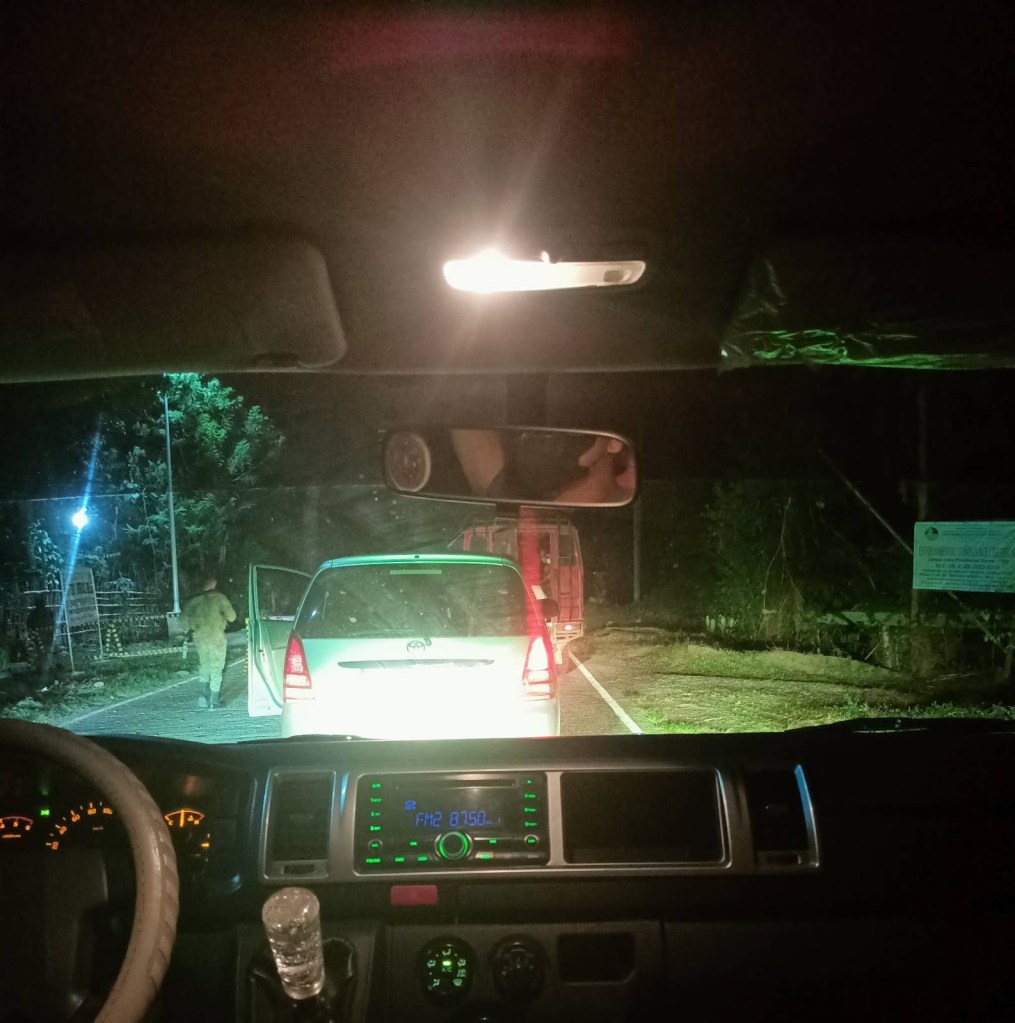
As the convoy was approaching Tabuk City at about 7:00 PM, another military checkpoint at barangay Bantay flagged all the vehicles of the health workers and volunteers. A certain officer who introduced himself as the Lt. Col. Floyd Gano, the commanding officer of the 50th IB of the checkpoint team said his men from the first checkpoint reported “binastos sila ng nasa van” (they were disrespected by the passengers of the van).
The medical mission team explained what transpired and denied any act of disrespect against the soldiers in the said checkpoint. As the negotiation was going on, the team observed armed soldiers positioning themselves covertly beside the road. Without any legal basis to hold their team longer, the health workers were able to assert that they did not violate any law and must then be allowed to proceed in their travel. They were able to leave the checkpoint before 8:00 PM.
In light of the government’s long record of violence and harassment against health workers who put their lives at risk in order to stay true to their oaths of profession and serve the people especially the sick, such actions of the military put a spotlight on the culture of impunity in the country where power bestowed upon a few can easily be abused. Without substantial precedents of accountability, human rights violations can easily become the norm.
Attacks against health workers, in any form, is an attack to the communities’ right to health. Directly targeting health workers cuts the people’s lifeline to care and treatment.
In 2020, the Department of Health said nearly 40% of the Philippine’s poorest municipalities are ‘doctorless”. A nurse meanwhile, attend to up to 80 patients per shift – a far cry from the ideal 1 nurse per 4 patients in a ward setting. There is also a longstanding lack of support to public health care facilities at all levels from the barangay health stations (BHS) to tertiary care hospitals. Of the country’s 42,045 barangays (smallest political unit in the local government), only 25,506 have health stations, despite the 1991 Local Government Code mandating every barangay to have at least one BHS. In 2021, the national average of Rural Health Unit to population ratio was 1:39,541. And in terms of life-saving medicines, 9 out of 10 Filipinos are unable to buy prescribed drugs. It is not surprising, therefore, that amid these conditions of health services, 4 out of 10 deaths are not medically attended, and more than half of recorded deaths occur at home.
The organizations said that it is unacceptable, if not outrightly condemnable, for the AFP unit who held the medical team in the checkpoints in Kalinga and accused them of disrespecting the soldiers manning the barricade. Such actions are a form of harassment, disrespect, and disregard to the health workers’ rights and safety as well as to the people’s right to health. Protect our health workers, stop the harassment.
 Council for Health and Development (CHD)