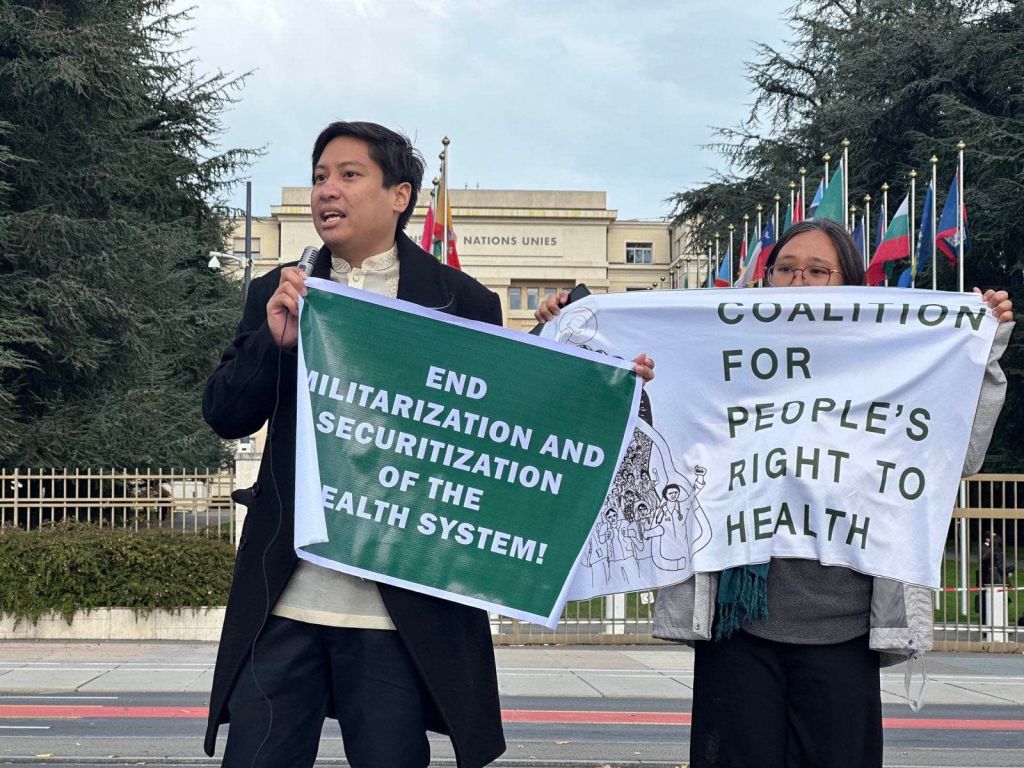
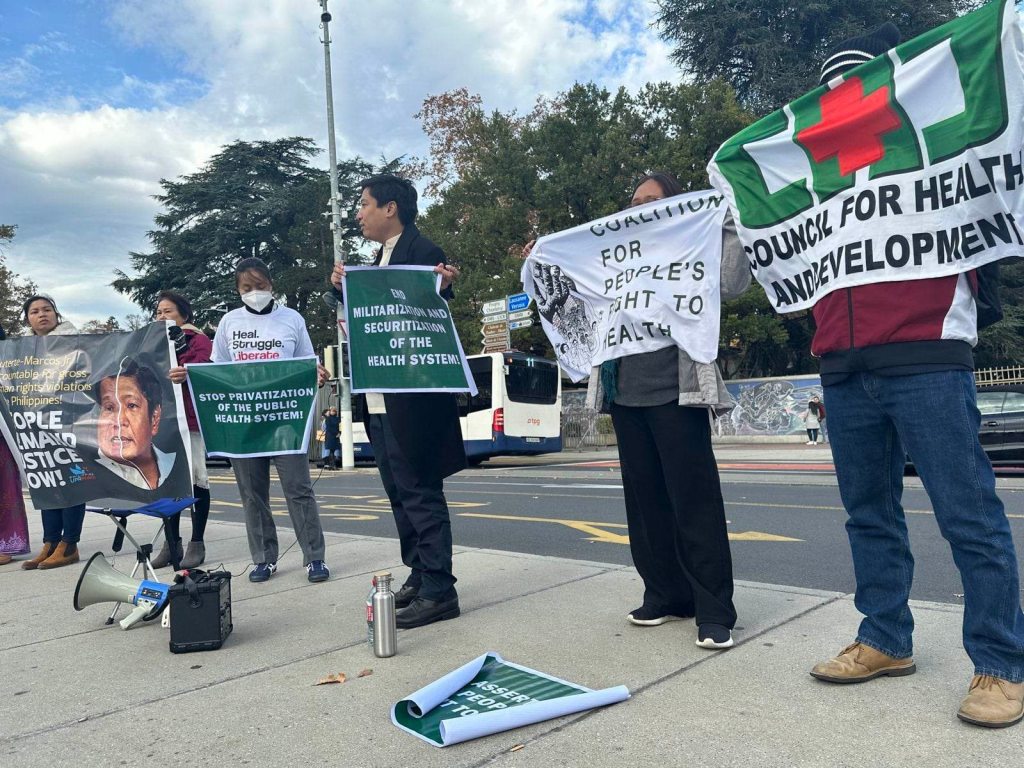
On International Human Rights Day, most Filipinos still do not enjoy a right to health; despite the pandemic, inequity in access to health services has risen amid marginal changes to infrastructure and budget—failing Constitutional and international obligations to protect and fulfill the people’s right to health and its defenders
The United Nations fully defines the right to health as “the right of everyone to the enjoyment of the highest attainable standard of physical and mental health.” Similarly, the 1987 Constitution cites the state’s responsibility to “protect and promote the right to health of the people and instill health consciousness among them.” On a day honoring the realization of human rights worldwide, the Coalition for People’s Right to Health asks, where is this right to health in our country and society?
According to the most recent Philippine National Health Accounts reported by the Philippine Statistics Authority, while health expenditure has been increasing, a significant amount still comes from household out-of-pocket payments, amounting to 41.5%; this means that many Filipino families still pay large amounts for their medical needs, competing with the rising costs of essential goods. This is despite the existence of the Universal Healthcare Law (UHC) and an accompanying national health insurance scheme (PhilHealth), whose premiums are again due to increase to 4.5% of one’s salary in the coming year (from 4% in 2022).
In a recent report by the World Bank on Poverty and Inequality in the Philippines, widening gaps were seen in terms of accessing social services such as healthcare, in that poorer households were less likely to utilize or seek health services. This most probably reflects the state of inadequate health facilities and personnel, exacerbated by the overwhelming of the fragile system amid a pandemic, as well as the exorbitant cost of medical services. Furthermore, the report highlighted that “UHC will not reach its full potential […] if it continues to be difficult to physically access facilities and specialists.” Meanwhile, the 2023 health budget will see the smallest increase in recent years, as per IBON Foundation.
Thus, it is clearly misleading when the state claims that UHC and the RH law are proof of its obligation to respect, protect, and fulfill the right to health, as it did in the most recent Universal Periodic Review (UPR) cycle last November 2022. There continues to be a failure to realize a human rights-based perspective on health issues, evident in the way the country has handled the problems of drug addiction, reproductive health, and the COVID-19 pandemic—as matters of personal responsibility and discipline, instead of enabling communities to access much-needed health services.
Indeed, the abuse of the right to health and its social determinants has led to countless more human rights violations. This is especially true in the situation of those who naturally defend the right to health: the frontline health workers and community advocates who demand a free, comprehensive, national public health system, yet face red-tagging, threats to their lives and security, or worse, outright silencing of their dissent. From the suppression of hospital unionists to the murder of Zara Alvarez and Dr. Mary Rose Sancelan in Negros Island, health human rights defenders remain persecuted and vulnerable, even if they seek the realization of a right enshrined in the Constitution and international health covenants.
CPRH challenges the Philippine government and Marcos administration to truly live out its claim to prioritize health by fulfilling its obligation to respect, protect, and fulfill the people’s right to health. This includes implementing the recommendations made by UN member states in the recent UPR cycle, such as building more health facilities and enhancing health services in the countryside, improving access to water, sanitation, and sewerage, the ratification of the Optional Protocols on Economic, Social and Cultural Rights (ESCR) and the Convention on the Rights of Persons with Disabilities (CRPD), a health and human rights-based perspective on the war on drugs, and the cessation of red-tagging as a state policy.
We call on the government to recognize the special mandate holders of the UN, and formally invite the Special Rapporteurs who have long requested a country visit, to independently investigate, analyze, and recommend actions for the health and human rights situation in the Philippines:
• Special Rapporteur on the right of everyone to the enjoyment of the highest attainable standard of physical and mental health – requested 13 June 2022
• Special Rapporteur on torture and other cruel, inhuman or degrading treatment or punishment – requested 24 January 2017, with subsequent reminders in 11 February & 25 November 2019, and 27 January 2021
• Special Rapporteur on extrajudicial, summary or arbitrary executions – requested 22 June 2021
• Special Rapporteur on the elimination of discrimination against persons affected by leprosy and their family members – requested 23 November 2018
As long as individuals and families bear the primary burden for seeking even the most basic of health services, health becomes a privilege rather than a right. When access to healthcare becomes a matter of political favor or economic status, the people are disempowered from asserting these rights. Worse, when the natural defenders of the right to health—doctors, nurses, hospital workers, and community health advocates—are persecuted and vilified, what regard is left for human rights? The highest attainable standard of health as a right of every Filipino is still far from reality, but one that we must continue to assert, from the communities to the clinics.
 Council for Health and Development (CHD)