PRESS STATEMENT
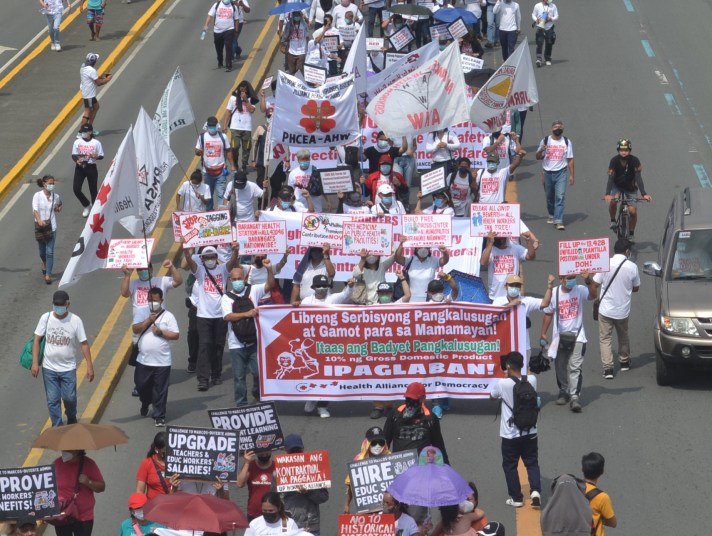
Health groups Alliance of Health Workers, Coalition for People’s Right to Health, Filipino Nurses United, Health Action for Human Rights, Health Alliance for Democracy, and Philippine Medical Students’ Association expressed their critique and counter-proposals to the recent SONA of Pres. Marcos Jr.
The president’s directives on health: Detached, shallow and vague
In the principles of logic, for an argument to be sound, it has to first be both valid and true. For the state of the nation’s health, President Marcos’ assertions are based on invalid assumptions and false truths that are detached from the people’s experiences with a broken health system.
Pres. Ferdinand Marcos, Jr. policy directives on health in his first State of the Nation are shallow and vague. Obviously detached from the realities of the day to day lives of communities and health workers alike, the directives actually reflect a poor grasp of the deteriorating health care system and lack appropriate solutions needed to address the worsening health of the Filipino people.
He enumerated measures to live with the COVID-19 pandemic such as continuing rollout of vaccines and declaring no lock out. However, these appear to be in the interest of recovering “full capacity” in business. Monitoring hospital utilization and setting up a Center for Disease Control and Prevention and a vaccine institute do not complete a scientific, systematic and comprehensive plan for COVID contact tracing, surveillance, monitoring, management and control from the household to the national level.
His concept of health is curative rather than preventive and hospital rather than community centric. Marcos Jr. fails to see the importance of basic fundamentals like good nutrition, community-based health system, clean air and environment, and safe water supply to promote health and wellness. He is detached from the reality of poverty and its interrelation to health where four out of 10 Filipinos die without ever receiving medical attention.He said that his administration would set up additional rural health centers where a doctor, nurse, midwife and medical technologist would be deployed once or twice a week. He is not grounded that health emergencies and illnesses may happen anytime. There is a need for the availability of health personnel on a 24 hours and seven days basis. Our health workers from the community frontlines work daily to attend to the populations’ needs despite barely any supplies, medicines and equipment.
To ensure the health of the people at the community level, including the geographically isolated and depressed communities, health professionals should be available. There should be health professionals with regular positions (plantilla) in the public health care system to approximate the ideal patient to personnel ratio. Concretely, these include additional 3,268 public health doctors in 1,490 towns and 144 cities or two doctors per town; 42,046 positions for nurses or a nurse per barangay, and 42,046 positions for midwives or a midwife per barangay. They could ensure health education on the household level.
Though much applauded, setting up specialty hospitals like the Philippine Heart Center, Lung Center, Philippine Children’s and Medical Hospital and National Kidney and Transplant Institute outside of the National Capital Region is political grandstanding. Where would the funds come from? Public-private partnership and government owned and controlled corporations schemes that are concerned with generating revenues and profit from government hospitals should not be allowed. So as to immediately improve the level of specialty care on the provincial and regional level, the government should earmark funds from the national budget to upgrade the equipment of these existing government hospitals with specialty units like heart, kidney and lung units to provide free specialty services for less complicated operations on these levels.
When it comes to the availability of medicines, Marcos Jr. is interested in opening up the local market to foreign pharmaceutical companies to bring down prices of medicines. Competition works in big business but would kill the fledgling Filipino drug industry. National priority should be given to removing the value-added tax and regulating the price of medicines as well as developing a national drug industry that includes the development of herbal medicine. Safe and effective medicines should be free and available in all government centers and hospitals.
Much to the dismay of health workers, his declaration on the welfare of health workers was vague. While he recognized the need for competent and efficient medical professionals, he was silent on the demand of health workers for just wages, tax-free, and timely release of COVID benefits and compensation for health workers in the public and private sectors. He did not include directives to end contractualization of health workers and to add plantilla positions for doctors, nurses and midwives.
Neither did Marcos Jr. say anything on the red-tagging and killings of municipal health doctors as well as doctors and health workers who work in the communities. Though in some cases the killer has been identified, there has been no arrest and accountability. Threat to life and unjust killings discourage doctors and health personnel who choose to work in remote areas to provide health services.
Throughout his speech regarding health, his policy directives show that his paradigm for health is related to making business and profit from health by kowtowing to the neo-liberal policies of privatization and liberalization of health services and goods. His policies are focused on consumer-driven and profit-oriented health programs.
Like his predecessors, Marcos Jr.’s denialism of the worsening health of the people is evident. He dismissed the agenda that directly impacts on people’s health and shows state responsibility for the provision of health care. The Filipino people need free health care services and free medicines from the barangay to the national level. Health centers should be set up in every barangay with a complement of adequate health personnel, laboratories, supplies and equipment. This is achievable by allocating 10 percent of the gross domestic product for health.
There should be money for health and not from health. Corruption has no room in health. Offenders should be held responsible and arrested.
Continue the fight for the people’s right to health, health workers’ living wage and adequate protection, and social justice. ##
Signatories:
Mr. Robert Mendoza
Alliance of Health Workers
Dr. Joshua San Pedro
Coalition for People’s Right to Health
Ms. Maristela P. Abenojar, RN, MAN
Filipino Nurses United
Mr. Albert Pascual
Health Alliance for Democracy
Ms. Joyce Brillantes
Philippine Medical Students Association

 Council for Health and Development (CHD)