
This time last year, South Africa and India filed a proposal at the World Trade Organization seeking to remove intellectual property barriers and waive patents on diagnostics, medicines, vaccines, and technologies that will prevent, treat, and contain the pandemic. Since then, over 100 countries around the world have backed the move, including most African and Asian nations, as well as the United States, Australia, New Zealand, France, Russia, and China. But opposition from the European Commission and a need for consensus at the WTO prompted negotiations on the matter.
Inequities in health are further being revealed by the pandemic as well as in the response globally. Vaccine distribution continues to be unfair among and especially within countries, with some nations having more doses than what their population actually needs, while poorer states and provinces scramble for any vaccine. Communities
languish amid increasing infections, as the privileged easily attain herd immunity and are already even giving out booster doses.
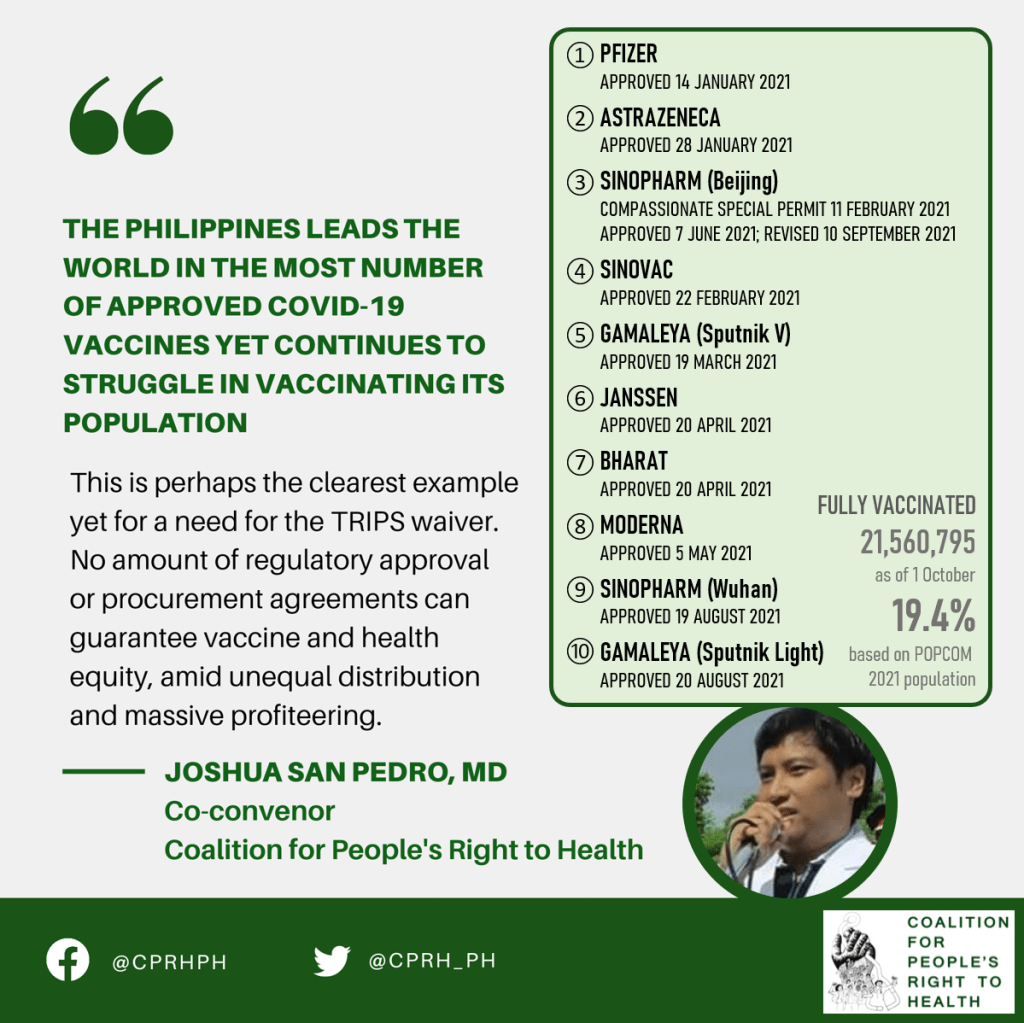
The Philippines meanwhile leads the world in the most number of approved COVID-19 vaccines, but continues to struggle in vaccinating its population. It has recently fallen to the bottom of Bloomberg’s COVID-19 resiliency ranking at 53rd. Government pronouncements have highlighted the lack of vaccine supply, yet does not acknowledge the question of inequity on an international scale—one that the TRIPS waiver dares to answer by providing more opportunities to manufacture and produce vaccines outside the profit-oriented pharmaceutical monopolies.
With almost 20% of the country’s 110-million citizens fully vaccinated, such services are still not truly accessible due to frequent shortages and a prioritization scheme still in place. Instead of transparently addressing the glaringly inequitable distribution, no coherent position on the proposal at the WTO has been put forward. CPRH has tracked affirmative positions from certain DOH and DFA officials, but has not seen a categorical stance from these agencies as a whole. In contrast, the DTI and Intellectual Property Office (IPO) are reluctant to support while the IATF/NTF is silent.
Through the invaluable help of a congressional inquiry, we have learned that there have indeed been Technical Committee on WTO Matters (TCWM) meetings on the TRIPS Waiver as well as the so-called “counter-proposal” by the European Union that merely pushes existing flexibilities on the status quo instead of overhauling it amid a public health emergency. However, it was mentioned in the DFA’s official response that these would “be looked in to by the TCWM small group.” despite the fact that the revised waiver was filed on 21 May, and the counter-proposal on 4 June 2021.
The TRIPS Council meets in a matter of days—informally on 4 October and formally on 13-14 October—the Coalition argues that the Philippines cannot afford to remain mum on the matter. CPRH calls on health workers, health advocates, and the wider public to clamor for an official and firm commitment towards supporting the TRIPS Waiver proposal from the various government agencies leading in the COVID-19 pandemic response. As negotiations come to an end, the Philippines must be in solidarity with the people clamoring for a more equitable and proactive pandemic response.
With a desperate situation of record-high cases and a persistent lack of technologies including vaccines, evident with the approval of 10 vaccine brands (with an additional in process) becoming the most in the world, the case of the Philippines is perhaps the clearest example yet for a need for the TRIPS Waiver. Ultimately, no amount of regulatory approval or procurement agreements can guarantee vaccine and health equity, amid unequal distribution and massive profiteering.
PHILIPPINES, DON’T WAVER ON THE WAIVER!
OFFICIALLY SUPPORT THE TRIPS WAIVER NOW!
IMPLEMENT AN EQUITABLE, GROUNDED, AND RIGHTS-BASED RESPONSE TO THE PANDEMIC!
 Council for Health and Development (CHD)